
How to Build a Strong Portugal Visa Application in 2026: Documents, Financials & Checklist
Portugal remains one of the most sought-after destinations for retirees, remote workers, and entrepreneurs; and if you’re preparing a Portugal visa application in 2026, there’s one critical update you need to know first.
If you applied before, or started researching in 2025, some of the figures you have may already be outdated. This guide walks you through what’s changed, what stays the same, and how to build an application strong enough to get approved first time.
What Visa Types Are Available in Portugal in 2026?
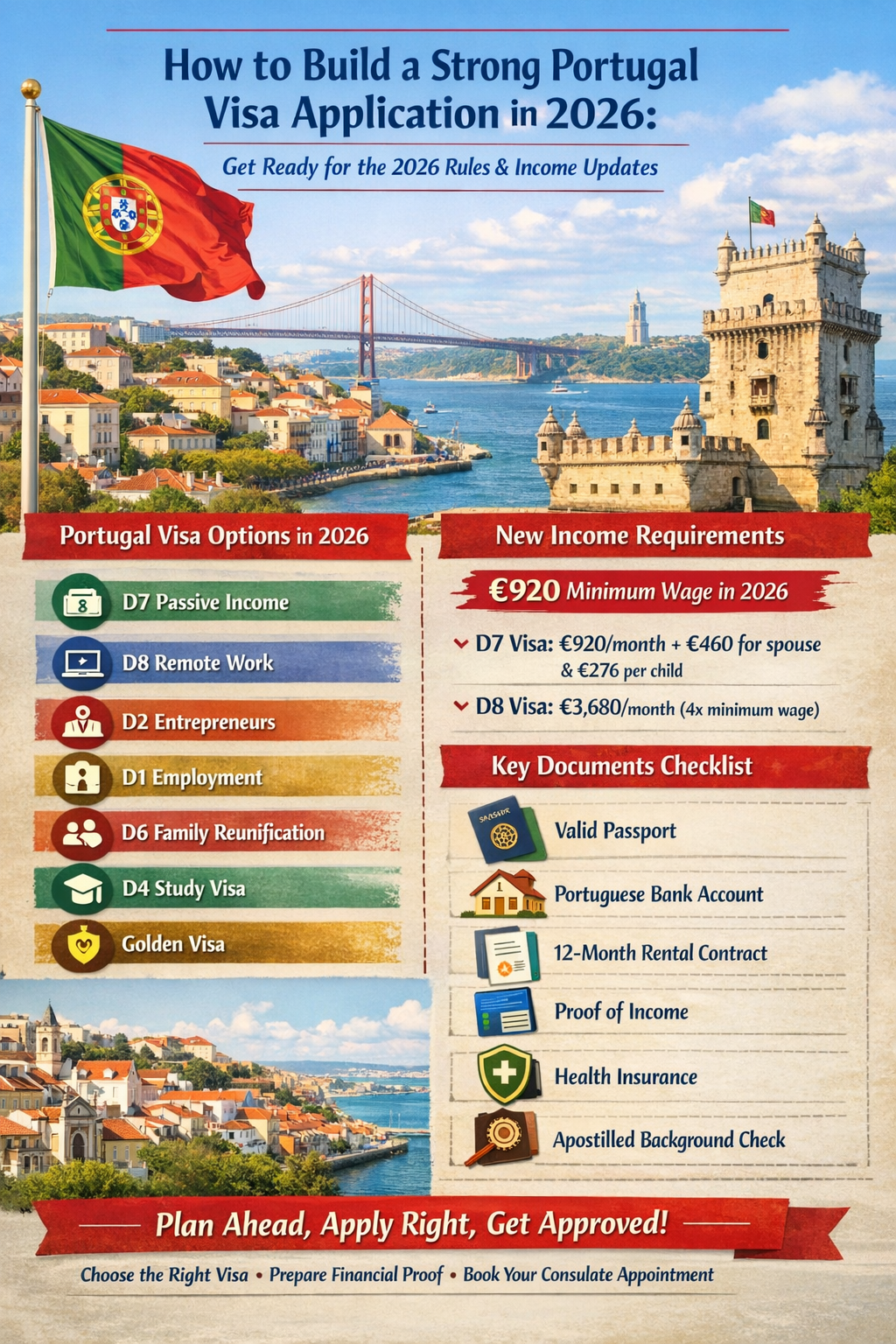
Before diving into documents and financials, make sure you’re applying for the right visa:
- تأشيرة D7 — for retirees and people with passive income (pensions, rental income, dividends)
- D8 Visa — for remote workers and freelancers employed by foreign companies
- D2 Visa — for entrepreneurs, investors, and self-employed professionals
- D1 Visa — for people with a labor contract or a promise of a labor contract with a Portuguese company
- D6 Visa — for spouses, minor children, dependent adult children, and dependent parents of a legal resident or citizen in Portugal
- D4 Visa — for people enrolled in recognized educational programs in Portugal, including university degrees, exchange programs, internships, or secondary education
- D3 Visa — for professionals with specialized qualifications or experience hired by a Portuguese company in a highly qualified role (e.g., engineers, IT professionals, scientists, senior managers), typically with a salary of at least 1.5× the national average gross salary
- Golden Visa — for investment-based residency (real estate, funds, job creation)
Applying for the wrong type is one of the most common and costly mistakes applicants make. Consulate officers will notice mismatched documentation quickly.
2026 Portugal Visa Application Requirements: What the €920 Minimum Wage Means for You
Portugal calculates minimum income thresholds for visa purposes based on the national minimum wage, which rose to €920/month in 2026. Here’s how that breaks down:
D7 Visa (Passive Income)
- Main applicant: €920/month in passive income
- Spouse or partner: add €460/month (50%)
- Each dependent child: add €276/month (30%)
So a couple with one child would need to demonstrate at least €1,656/month in passive income.
D8 Visa (Remote Work)
- Remote workers must earn at least 4x the minimum wage
- In 2026, that means €3,680/month gross
D2 Visa (Entrepreneurs)
- No fixed minimum, but you must demonstrate sufficient funds to launch a business and support yourself during the startup phase. A clear business plan with realistic financial projections is essential.
Savings as a Supplement
Consulates also look at savings as a stability indicator, even when monthly income meets the threshold. The legal requirement is having 12 months’ worth of the required income held in a Portuguese bank account.
Step-by-Step: How to Build a Strong Portugal Visa Application in 2026
1. Choose the Right Visa and Confirm Your Consulate’s Requirements
Portugal’s applications go through local consulates or VFS Global offices, and each has slightly different instructions. Check the specific website for your jurisdiction — San Francisco, New Jersey, London, and others all have their own forms and formatting requirements.
2. Gather Your Core Documents
While specifics vary by visa type and consulate, most Portugal visa applications in 2026 require:
- Valid passport (minimum 6 months validity beyond your intended stay)
- NIF (Tax Identification Number): obtain your NIF before anything else – it’s required to open a Portuguese bank account and sign a rental contract. Get your NIF remotely through MSP Lawyer.
- Completed visa application form
- Two recent passport photos
- Portuguese bank account showing required funds
- Proof of income: bank statements, pension letters, employment contracts, or payslips
- Proof of accommodation: rental contract (minimum 12 months), property deed, or host letter
- Criminal background check (apostilled)
- Travel health insurance (minimum €30,000 coverage)
- Letter of intent
3. Meet the Lease Requirement
For D7 and D8 visa applicants, Portugal requires proof of accommodation and this is where many applications stumble. A standard 12-month rental contract is the most straightforward option. Short term accomodation, like airbnb, is not accepted.
4. Write a Compelling Letter of Intent
This document carries more weight than many applicants expect. A strong letter of intent clearly explains:
- Why you are moving to Portugal
- How you meet the visa requirements
- Where you plan to live
- Your long-term intentions in the country
Keep it professional but personal. Vague or generic letters stand out for the wrong reasons.
5. Apostille and Translate Your Documents
Any government-issued document, like background checks, birth or marriage certificates, must be apostilled.
6. Book Your Consulate Appointment Early
Some Portuguese consulates are booking 2 to 4 months out. Book as soon as your documents are in order. Bring originals, copies, and organize everything in the same sequence as the consulate’s checklist.
2026 Portugal Visa Application Checklist
| Document / Task | Notes |
|---|---|
| Valid passport | 6+ months validity |
| Visa application form | From your local consulate |
| Passport photos | Usually 2, white background |
| NIF (Portuguese tax number) | Can be obtained remotely |
| Portuguese bank account | With required funds on deposit |
| Proof of income | Updated to 2026 thresholds |
| Proof of accommodation | 12-month rental contract preferred |
| Health insurance | €30,000 minimum coverage |
| Criminal background check | Apostilled |
| Letter of intent | Clear, personal, and specific |
| Document translations | Into Portuguese where required |
| Apostilles | On all required official documents |
| Consulate appointment booked | Book well in advance |
| Visa fee payment ready | Confirm accepted method with consulate |
Frequently Asked Questions
The minimum is €920 per month for the main applicant, based on Portugal’s 2026 national minimum wage. Add 50% for a spouse and 30% per dependent child.
Yes. Portugal’s minimum wage increased to €920 per month in 2026, up from €870 in 2025. This directly affects D7 and D8 visa income requirements.
In most cases, yes, if you don’t own property in Portugal. A 12-month rental contract is the standard requirement for proof of accommodation.
Yes, many people apply successfully on their own. However, complex situations like family applications, self-employment, or previous visa refusals, benefit significantly from professional guidance to avoid costly mistakes.
Final Thoughts on Your 2026 Portugal Visa Application
A successful Portugal visa application in 2026 comes down to three things: choosing the right visa type, meeting the updated financial thresholds, and presenting a clean and complete set of documents.
The €920 minimum wage increase is the most significant change from 2025, and if you’re working from figures published last year, now is the time to update your calculations.
Need help with your Portugal visa application? We offer document reviews, application guidance, and expert support tailored to your situation. Contact us to book a consultation.